Nightmare Wrapped in Skin
Acronyms expanded in this post:
- AI: Artificial Intelligence. software that generates, classifies, predicts, summarizes, or acts on patterns in data.
- IT: Information Technology. the practice of building, operating, and supporting computing systems.
Some emotions do not arrive as thoughts. They arrive as discharge from a wound that has lost the courtesy to close. They come out hot, infected, absurdly theatrical, like some municipal drain in Calcutta after rain, carrying flowers, plastic, dead insects, and one slipper belonging to a man nobody will ever identify. That is the trouble with despair. It is not dignified. It does not sit in a chair wearing a shawl and quoting Schopenhauer. It leaks. It smells. It embarrasses the furniture.
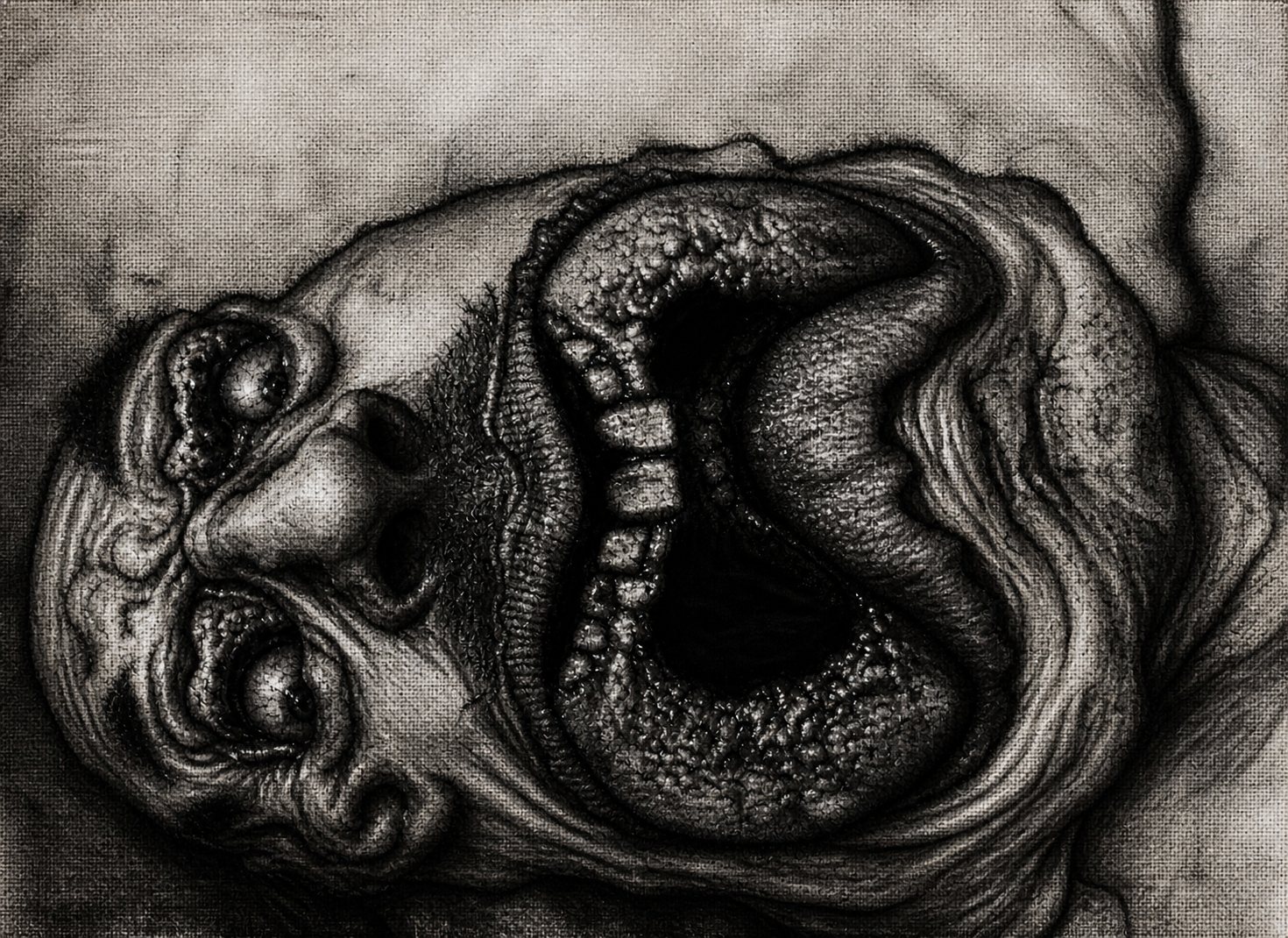
I have often felt less like a person than a weather report for incoming ruin. A nightmare wrapped in skin. Trauma wearing spectacles. A middle-aged warning sign standing beside the road, ignored by motorists who have already decided the bridge is probably fine. The future, in my head, is always standing under the shadow of the past, and the past is not an archive; it is a damp room where the walls have begun to grow opinions. Hope, when it appears, is brief and suspicious. It glimmers for a moment, then the old gloom comes back with a screwdriver and starts poking holes through the ceiling.
Of course, one can say this is chemistry. Wiring. Firing. Neurotransmitters doing their little corrupt elections inside the skull. Perhaps that is true. Perhaps all biography eventually becomes biology, and all philosophy is just a nervous system trying to explain why the lights flicker. But knowing that does not make the experience gentler. A man trapped inside a burning house may understand combustion perfectly and still object to being roasted.
The cheerful version of me, when it appears, is usually fraudulent. It stands out like jaundice. The laughter gets too loud. The sentences grow overfed. The mind starts behaving like a drunk magician pulling scarves, pigeons, invoices, and ancestral shame out of one small hat. Other people seem to possess emotional furniture: chairs, tables, cupboards, a sensible place to keep grief. I have a maze without an entrance or exit. You cannot visit me there. I cannot even visit myself properly. I simply keep turning corners and finding the same old wall, slightly wetter than before.
I am sad, mad, and occasionally ridiculous enough to be funny, which is the final insult. A fruit going bad still has shape. It can still sit in the bowl and pretend to belong to breakfast. But the dark spot spreads. The center softens. The little edible civilization collapses inward. This is not melodrama so much as inventory. One examines the stock and finds the warehouse full of damp cardboard, expired ambition, unpaid bills, and a few jars of stubbornness preserved in brine.
People have contributed. Let us not become falsely spiritual and pretend otherwise. Some lives are improved by those around them; others are expertly sanded down. There are people with a genius for making misery mainstream, for turning ordinary disappointment into an industry, for salting the ground and then asking why nothing grows. Yet even here, fairness intrudes like an unwelcome auditor. Maybe I played the hand badly. Maybe I mistook wounds for wisdom. Maybe I spent too long staring at the insult and too little time learning the machinery of escape. The difficulty is that half the game is already over, and many of the things that once gave dreams their voltage now look dead, not dormant.
The dread of another morning is not poetic when it actually arrives. It is a practical matter. The ceiling exists. The phone exists. The body insists on being carried forward like a troublesome suitcase. The world resumes with its usual impertinence. Tea. Toothache. News. Noise. Messages from people who need something. Bills. Dust. The small humiliations of remaining alive in a system that offers no orchestral accompaniment for survival. Life is not a hardbound collection of happy parables. It is often a mouthful of bitter pips, and if you swallow too quickly, you choke.
So I sleep. I hurry the hours. I sketch inner gargoyles until the hand gets tired and the demons begin to resemble clerks. I read because reading is the one form of disappearance that does not require leaving the room. A book is a legal tunnel. You enter through a sentence and, if the writer is any good, you are briefly smuggled out of yourself. Not cured. Not transformed. Just elsewhere. Elsewhere is not salvation, but it is something.
There is a sofa-cum-bed in this story because every tragedy requires furniture. Mine is cheap, dilapidated, loyal in the manner of failed objects. It is less a bed than an agreement between wood, cloth, gravity, and resignation. Yet it is mine. It holds the body while the mind conducts its municipal strikes. It is an accessory to a life I have often described with the vocabulary of drains, mess, and Bengali middle-class collapse, but it is also, in its collapsed way, enough. A bed. A book. Some tea. A working fan. The occasional sentence that does not entirely disgust me.
People ask, “What books do you read?” This is a strange question to ask a depressed person, though not an unkind one. It has the quality of someone examining a crashed tram and asking what brand of bell it used. There is an assumption that somewhere in the reading history lies the contaminant, the cursed volume, the one sentence that turned the child into this adult calamity. As if misery were a syllabus and one could avoid the wrong chapters.
But childhood, for me, was not a gothic corridor lined with forbidden books. It was Tintin. That little quiffed reporter and his dog, running across the globe through plots that were absurd, imperial, charming, dated, brisk, and full of trapdoors. Tintin was not therapy. Tintin did not explain the future. He simply moved. He ran, flew, sailed, chased, escaped. For a child, that was enough. Motion itself was a kind of mercy.
There was some Asterix too, though I never loved it with the same appetite. Too much antic foam, perhaps. Too much cleverness wearing a helmet. I preferred the stranger middle territory: The Phantom, Mandrake the Magician, Rip Kirby, Flash Gordon. Heroes not quite real, worlds not quite impossible, adventures that gave the ordinary day a secret exit. They had style, shadow, danger, and enough nonsense to prevent the imagination from becoming a government office.
Then came the local republic of childhood madness: Handa Bhonda, Batul the Great, Nonte Fonte. Narayan Debnath understood something essential about Bengali life: that chaos is not an interruption of order but often the order itself. His panels had the speed of a para argument, the elasticity of a schoolboy lie, the physics of a universe where blows landed loudly and nobody appeared to require orthopedic care. They were ridiculous, yes, but honest in the way absurdity can be honest. The world was unruly. People were greedy, foolish, boastful, hungry, inventive, vain. In other words, recognizable.
Satyajit Ray and Shirshendu Mukhopadhyay added other rooms to the house. Mystery. Intelligence. Wonder. A Bengali child could wander through those pages and feel that the mind had windows. Not escape exactly. More like ventilation. The air moved. Something in the ordinary lane, the old house, the eccentric uncle, the strange visitor, the impossible clue, could widen suddenly into enchantment. This mattered. A child does not need a manifesto. He needs proof that the visible world is not the only one.
None of this explains why I became this. That is the joke. People want causes because causes make suffering look tidy. But a life is not a laboratory rat with one labeled stimulus and one measurable squeak. It is inheritance, temperament, accidents, class, money, humiliation, misreadings, illness, weather, family, bad timing, foolish choices, unkind people, missed chances, private chemistry, and the slow bureaucratic incompetence of the universe. Add them together and you get a person. Or, in my case, a person-shaped complaint with reading habits.
Maybe I grew up too fast. Maybe I did not grow up at all. Maybe both things happened, which is how many lives actually break: one part becomes ancient while another remains eight years old, still waiting near the comics stall with a coin in hand. The adult learns dread, rent, dentistry, betrayal, and the market price of irrelevance. The child still wants a story where the hero escapes through a hidden passage and the dog survives.
I do not believe human lives are treasure chests of meaning. That is usually the language of people selling conferences, therapy packages, or scented candles. Much of life is maintenance. Much of it is digestion, delay, compromise, and pretending not to notice that time has teeth. But meaning, when it comes, may not arrive as a grand revelation. It may arrive as a stubborn paragraph. A joke made in bad taste but good rhythm. A sketch of a gargoyle. A memory of Tintin running toward trouble with Snowy at his heels. A cheap bed that has not yet collapsed. A book waiting where the day cannot entirely reach it.
This is not redemption. I distrust redemption. It often arrives overdressed and underexamined. This is only a small factual statement from the drainage edge: even a bleak life contains objects that hold. A page. A line. A childhood panel. A ridiculous hero. A dog. A fan. A cup of tea. A sentence that says the skull is lying today with unusual confidence, and perhaps one need not obey it immediately.
I remain an odd human being. That may be the most accurate diagnosis available without paperwork. I am not a model of resilience, not an inspirational comeback, not a phoenix, not a TED Talk with digestive trouble. I am a middle-aged Bengali man with a battered inner weather system, a taste for books, a sofa-cum-bed, and too many metaphors from the sewage department. But I am still here, which is not triumph, exactly. More like a clerical error in favor of continued existence.
And for today, that will have to do.